

The Bottom Line at a Glance: A business therapist is a state-licensed mental health professional (such as a Psy.D., Ph.D., or LPC) specializing in executive mental health, co-founder conflict, decision fatigue, and burnout. Unlike executive coaches who work on external tactics, business therapists address the underlying psychological patterns and nervous system strain that drive leadership behavior.
In my seventeen years of clinical practice, I have sat across from hundreds of founders, executives, and high-growth operators.
Most arrive at the exact same wall. Their calendar is organized, their KPIs are tracked, and their operational systems work well enough on paper. Yet beneath all that structure, they are dealing with paralyzing hesitation on major decisions, chronic insomnia, or toxic co-founder friction that puts the company at risk.
When leaders hit this wall, they almost always reach for tactical playbooks. They hire an executive coach, download another productivity tool, or commit to a morning meditation routine.
When those tactics fail to relieve the weight, they blame their own discipline.
It is almost never a discipline problem. The friction you feel is rarely an operational shortfall. It is usually an unaddressed psychological pattern.
Solving it requires more than standard business advice. You need a licensed clinical professional who understands high-stakes business environments: a business therapist.
Key Takeaways for High-Growth Leaders
- Clinical Licensure Is Non-Negotiable: A business therapist must hold an active state clinical license (Psy.D., Ph.D., LPC, LCSW, LMFT). Unlicensed coaches cannot diagnose conditions, treat clinical distress, or offer HIPAA-protected confidentiality.
- Root Causes vs. Performance Tactics: Executive coaches focus on conscious performance and habits. Business therapists treat the underlying anxiety, emotional defense mechanisms, and nervous system dysregulation behind the behavior.
- Eliminating the Referral Gap: Practices with dual-licensed clinicians allow leaders to move directly from formal diagnostic evaluations (such as adult ADHD or executive functioning testing) into ongoing therapy without restarting their history.
- Multi-Party Confidentiality Protocols: Working through co-founder conflict requires an explicit “No-Secrets Policy” and shared privilege to protect organizational trust and avoid triangulation.
What Is a Business Therapist? (And Why High-Growth Leaders Need One)
A business therapist is a licensed mental health clinician who integrates clinical psychotherapy with an understanding of organizational systems, corporate pressure, and leadership psychology. Rather than treating work and mental health as separate worlds, a business therapist looks at how your cognitive habits, attachment styles, and stress responses shape how you run your company.
The Psychological Toll of High-Stakes Leadership
Leadership is quiet, isolating work.
As a founder or executive, you carry fiduciary and operational responsibilities you cannot share openly with your board, your team, or even your partner at home. When sales dip, funding rounds stall, or leadership teams fracture, your nervous system remains stuck in fight-or-flight mode.
Biologically, chronic stress floods your system with cortisol and adrenaline. Over months and years, this sustained hormonal dump impairs the prefrontal cortex. That happens to be the exact brain region handling critical executive functions:
- Long-range strategic thinking: Building sound multi-year plans while managing ambiguity.
- Emotional self-regulation: Staying calm during board battles or personnel issues.
- Working memory and cognitive flexibility: Shifting priorities quickly when circumstances change.
- Objective risk assessment: Telling the difference between real business threats and imagined disasters.
When your prefrontal cortex is exhausted, work feels heavier. You begin second-guessing decisions that used to take seconds. You put off uncomfortable personnel meetings. You start reacting impulsively to routine hiccups.
Clinical Psychology Meets Organizational Reality
Traditional psychotherapy often treats work as mere scenery. A counselor who has never worked with corporate leaders might suggest you “set clear boundaries” or “shut your laptop at 5:00 PM.”
If you have a 50-person payroll to make by Friday, advice like that is useless.
A qualified business therapist knows your business is a living, demanding ecosystem. They do not expect you to turn off your ambition. Instead, they give you clinically validated tools to handle high-stakes pressure while protecting your sleep, focus, and relationships.
Using modalities like Cognitive Behavioral Therapy (CBT) and systems psychology, business therapy helps you catch cognitive distortions before they cost you money. You learn to stop treating a lost client like the end of the business, and you stop equating your self-worth with your company’s balance sheet.
Resetting these thought loops frees up the mental bandwidth you need to lead clearly.
Business Therapist vs. Executive Coach vs. Traditional Therapist
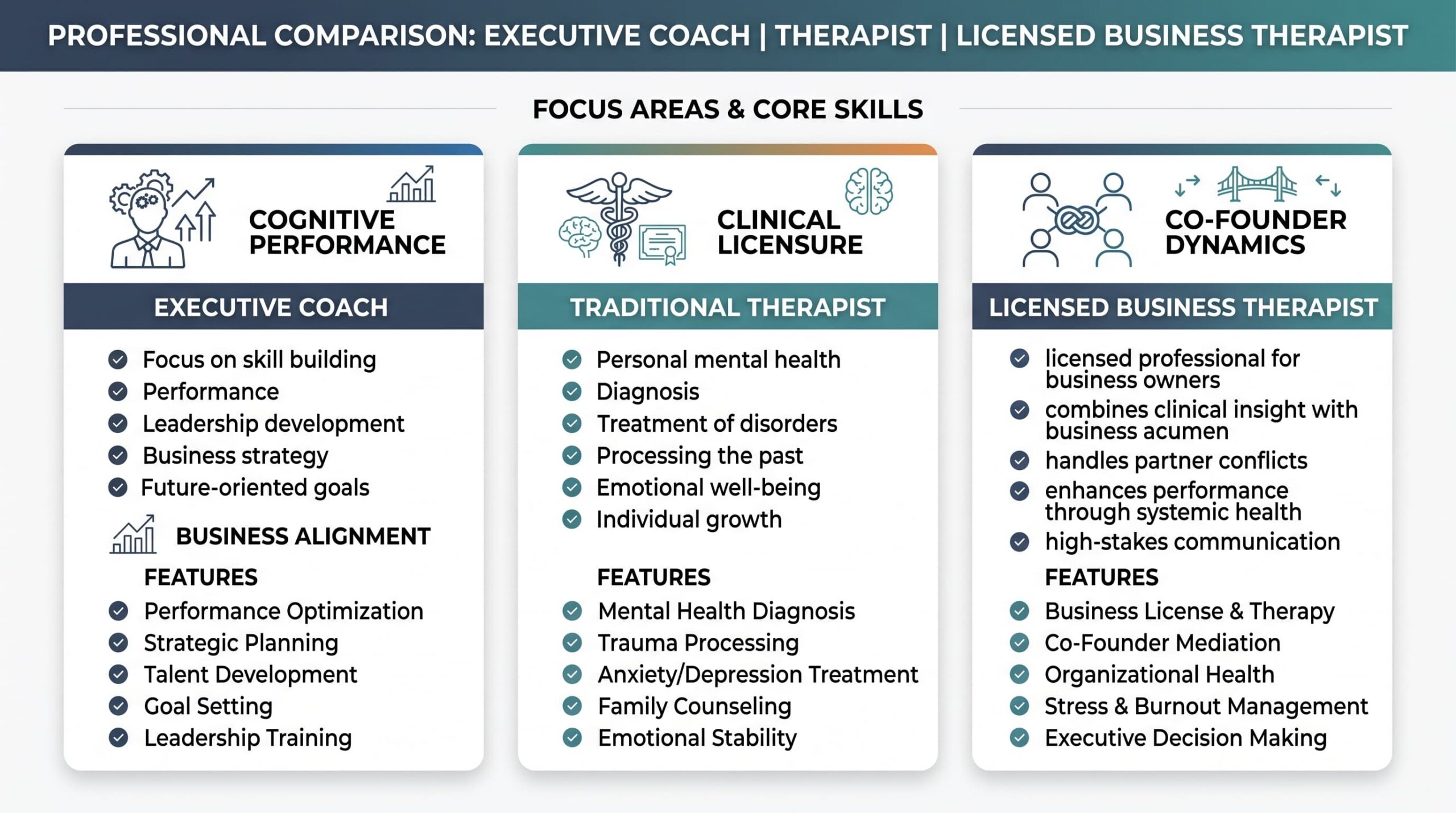
Founders frequently ask: “How is this different from executive coaching, or from the counseling I did years ago?”
Drawing clear boundaries matters. Conflating these three roles leads to misallocated capital, wasted time, and untreated clinical symptoms.
The Tri-Fold Scope & Methodology Matrix
| Evaluation Parameter | Traditional Psychotherapist | Executive Coach | Licensed Business Therapist |
| Clinical Licensure | Mandatory (Psy.D., Ph.D., LPC, LCSW, LMFT) | None required (May hold unaccredited coaching certificates) | Mandatory (State-licensed mental health professional) |
| Primary Focus | Personal history, mental health diagnoses, and individual healing | Future goal-setting, operational performance, and leadership habits | The intersection of mental health, leadership psychology, and workplace friction |
| Clinical Scope | Diagnoses and treats DSM-5 conditions (Depression, Anxiety, ADHD, Trauma) | Cannot legally diagnose or treat clinical disorders | Diagnoses and treats clinical conditions within an organizational and leadership context |
| Primary Methodologies | CBT, Psychodynamic, EMDR, Acceptance & Commitment Therapy (ACT) | OKRs, 360-degree reviews, accountability frameworks, role-playing | Evidence-based clinical therapy (CBT, ACT, Systems Theory) integrated with executive dynamics |
| Handling of Co-Founders | Typically individual-focused or personal couples counseling | Facilitates team alignment, strategic vision, and role clarity | Clinical mediation of interpersonal dynamics, relational patterns, and systemic conflict |
| Regulatory Oversight | Governed by state licensing boards and legal ethics codes | Unregulated by state healthcare boards | Governed by state licensing boards, HIPAA, and clinical ethics codes |
Why Coaching Alone Falls Short for Psychological Friction
Executive coaching works well for operational skills. If you want to run tighter meetings, sharpen board presentations, or delegate more efficiently, hire a coach.
Coaching focuses entirely on conscious, day-to-day behavior.
When an executive struggles with deep imposter feelings, conflict avoidance, or severe burnout, the problem is rarely tactical. It is driven by unexamined emotional defenses, perfectionism learned in childhood, or an underlying mood disorder.
Using coaching tactics on clinical anxiety or unaddressed trauma is like painting over cracked drywall: the surface looks fine for a week, but the foundation remains broken.
Eliminating the “Referral Gap” Through Dual Licensure
The traditional mental health system creates an annoying problem called the referral gap.
An executive gets tested by an independent psychologist, receives a 20-page diagnostic report, and gets told to go find an outside therapist for treatment. The executive then spends weeks searching for a provider, only to restart their story from day one with someone who knows nothing about psychological testing or startup culture.
At Open Minds Psychological, we built our practice to remove that hurdle. As a dually licensed psychologist (Psy.D.) and licensed professional counselor (LPC), my clinical approach allows clients to transition straight from formal diagnostic testing into ongoing therapy without delays or handoffs.
Whether you need testing for adult ADHD, executive functioning evaluations, or specialized therapy through our GREW Program (Growth, Resilience, and Executive Wellness), having diagnostics and therapy under one roof saves you time and mental energy.
4 Critical Signs You Need a Business Therapist
Watch for these four red flags:
1. Chronic Decision Paralysis and Risk Catastrophizing
You postpone big decisions, demand endless rounds of data, or spend days agonizing over routine hires. Beneath this delay usually sits acute anxiety. When every operational decision feels like a threat to your survival, a business therapist helps you separate real business risk from personal anxiety.
2. Co-Founder Dynamics Resembling Marital Conflict
Co-founder partnerships carry immense emotional weight. They involve shared equity, opposing communication styles, power imbalances, and vulnerability. When disagreements turn into passive-aggressive silence, resentment, or open defensiveness, you are not facing an operational disagreement. You are dealing with a relational breakdown that requires clinical mediation.
3. Complete Identity-to-Metric Enmeshment
If a down month in revenue or a sharp critique from an investor sends you into a depressive spiral, your self-worth is entirely tied to the business. A business therapist helps you untangle your identity as a human being from your performance as an executive, giving you the objectivity you need to steer the company.
4. Somatic Symptoms and Sleep Disruption
When your mind cannot process any more stress, your body takes the hit. You might notice insomnia, 4:00 AM panic spikes, persistent stomach issues, headaches, or an inability to relax even when you leave the office. These are clear physical warnings that your nervous system is overwhelmed and needs stabilization.
How to Find and Vet a Qualified Business Therapist: A 5-Step Guide
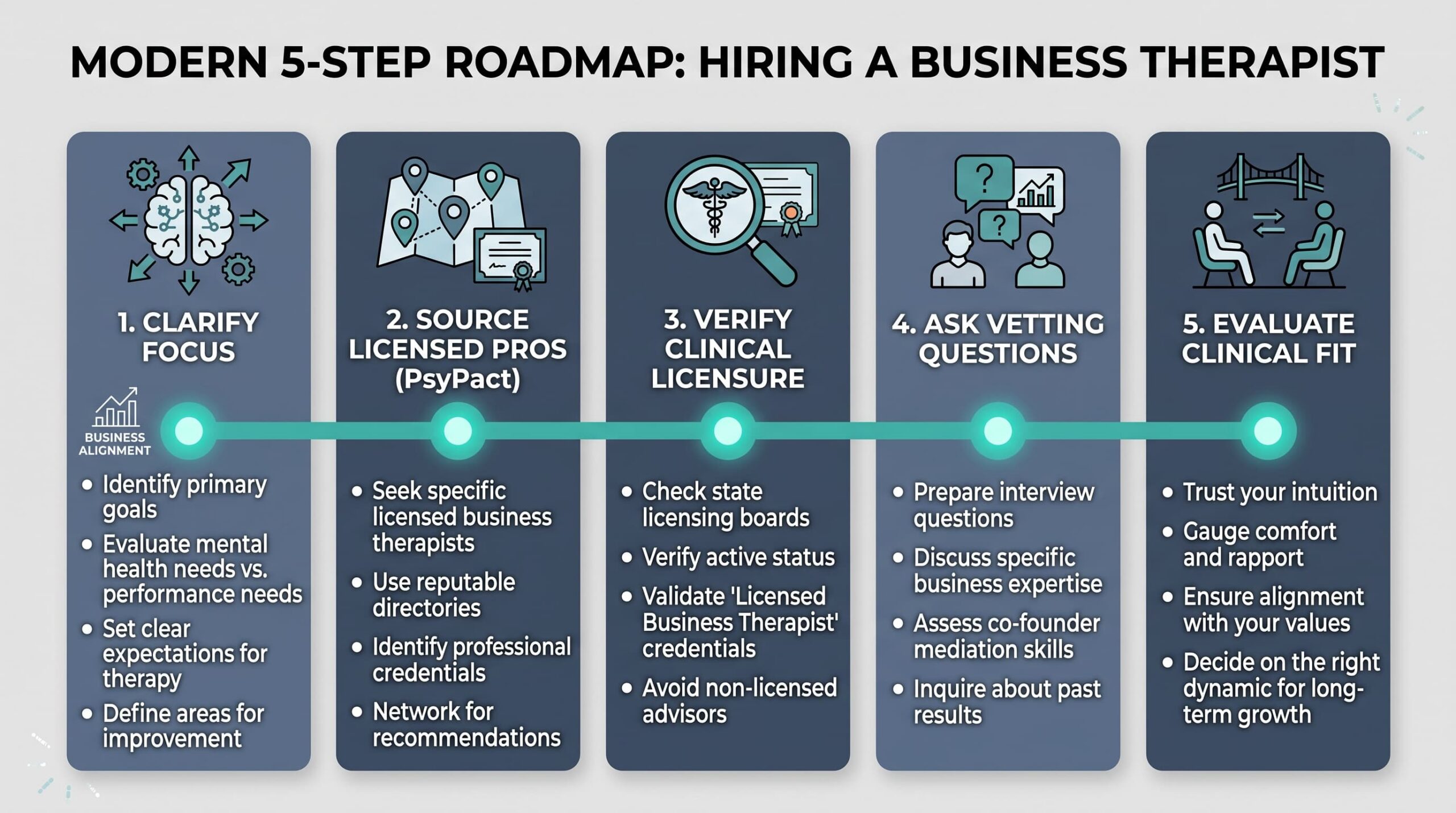
Because “business therapy” is a growing niche, you will encounter a mix of licensed clinicians and unlicensed coaches using clinical phrases to market their services.
Use this 5-step vetting process to find a qualified practitioner:
Step 1: Clarify Your Primary Focus
Before setting up discovery calls, identify the primary issue you need to address. Determine whether you need:
- Individual executive therapy: Treatment for chronic anxiety, mood shifts, or career burnout.
- Psychological assessments: Formal testing for adult ADHD, cognitive processing, or executive functioning deficits.
- Joint co-founder mediation: Clinical counseling to resolve relational conflicts and communication impasses.
Knowing your core objective helps prospective clinicians tell you immediately if your goals fit their practice.
Step 2: Source Licensed Mental Health Professionals
Skip general social media ads, where unregulated coaches dominate paid search. Instead, rely on established clinical resources:
- State Licensing Boards: Review state registries for licensed psychologists (Psy.D./Ph.D.) or licensed professional counselors (LPC/LMFT).
- The PsyPact Directory: If you travel frequently or need telehealth outside your home state, confirm the psychologist holds PsyPact authorization, which allows legal practice across 30+ states.
- Confidential Executive Peer Networks: Ask founders in trusted peer groups (such as YPO, EO, or personal mastermind circles) for referrals to licensed clinicians experienced with leadership stress.
Step 3: Verify Clinical Licensure vs. Coaching Titles
Confirm that any practitioner you consider holds an active, unencumbered state license.
If an advisor calls themselves a “business therapist” or “founder counselor” but has no state license, they are legally an unlicensed coach and cannot practice psychotherapy.
Look for designations like Psy.D., Ph.D., LPC, LCSW, or LMFT. Unlicensed consultants are not subject to HIPAA privacy standards, cannot treat mental health disorders, and lack the training to manage acute crises.
Step 4: Ask These 5 Essential Vetting Questions
Treat your initial 15-minute consultation as an interview. Use these five questions to gauge their qualifications:
- “What is your clinical background, and how does that training shape your work with leaders?”
- Listen for: Grounded clinical frameworks (like CBT, systems theory, or psychodynamic training) paired with practical knowledge of business environments.
- “Have you worked with executives at my stage of business (seed-stage, private-equity-backed, or enterprise)?”
- Listen for: Practical familiarity with your world, so you do not waste session time explaining dilution, cap tables, or board dynamics.
- “How do you separate business consulting from clinical therapy in your sessions?”
- Listen for: Clear clinical boundaries. A qualified therapist will emphasize that they are there to help your psychological functioning, not to overhaul your marketing funnel.
- “If we do joint co-founder sessions, what is your policy on confidentiality and individual disclosures?”
- Listen for: A structured “No-Secrets Policy” that protects the transparency of the joint work.
- “How do we measure clinical progress and know when goals are met?”
- Listen for: Concrete, identifiable markers, including better sleep, lower anxiety scores, faster decision turnarounds, and healthier boundaries.
Step 5: Evaluate Clinical Fit in the Initial Consultation
Trust your read of the room during your consultation.
Do you feel understood? Does the clinician speak with calm, grounded authority, or do they offer vague wellness platitudes?
You need someone who respects the realities of your work while holding the backbone to call out your blind spots directly.
Multi-Party Confidentiality: Navigating Co-Founder & Board Dynamics
Working with co-founders or executive partners brings up distinct legal and relational challenges that require firm ethical boundaries.
Managing Privilege in Joint vs. Individual Sessions
In co-founder therapy, the client is the partnership itself, which requires shared legal privilege and clear communication rules.
This setup brings two important ethical guardrails:
- Privilege and Legal Confidentiality: In joint therapy, privilege is shared. Neither co-founder can unilaterally waive confidentiality regarding joint discussions without the other partner’s written consent.
- Separation of Individual Care: A therapist should not serve as both the joint co-founder mediator and the ongoing individual therapist for one partner. Doing so creates conflicts of interest and ruins clinical neutrality. If one partner needs focused individual therapy, they should work with a separate provider.
The “No-Secrets” Clinical Agreement
In our practice, we use a strict No-Secrets Policy for co-founder work.
Under this rule, if one partner contacts the therapist privately between sessions to share sensitive news, like an intention to leave or unvoiced resentment, the therapist will not keep that information from the other founder.
Instead, the clinician works with that individual to bring the topic into the open during the next joint session.
This approach keeps the room honest and prevents triangulation, making sure therapy remains a trusted space for real work.
Frequently Asked Questions About Business Therapy
Clarifying financial and legal boundaries early helps you use your resources wisely.
Is business therapy tax-deductible as a business expense?
Companies often cover executive coaching, leadership training, and organizational consulting as standard business expenses. However, psychotherapy used to diagnose or treat a medical or psychological condition is generally treated as a personal medical expense under tax rules. Talk to your CPA or corporate attorney to determine how to categorize these services for your business.
Does insurance cover business therapy sessions?
It depends on how your sessions are coded and whether you have a diagnosed clinical condition. When you receive individual psychotherapy for conditions like Generalized Anxiety Disorder, Depression, or Adjustment Disorders, health insurance plans often provide benefits. At Open Minds Psychological, we are in-network with Aetna, Lyra Health, and Spring Health, and we supply detailed superbills for out-of-network reimbursement. Executive coaching or partner alignment sessions that do not meet medical necessity standards are billed privately.
Can I work with a business therapist across state lines via telehealth?
Yes, provided your psychologist holds PsyPact authorization. PsyPact is an interstate compact allowing licensed psychologists to provide telepsychology legally across more than 30 participating states. If your provider is located in another state, check that they hold active PsyPact credentials before starting care.
How long does business therapy take to produce results?
Because executives tend to be action-oriented, business therapy runs on a structured timeline. Using Cognitive Behavioral Therapy (CBT) and systems tools, many clients report meaningful reductions in anxiety, decision fatigue, and partner friction within 8 to 12 weekly sessions. After meeting their initial goals, many leaders shift to bi-weekly or monthly sessions to maintain cognitive clarity.
Restoring Leadership Resilience: Next Steps
You cannot build lasting business growth on top of a fried nervous system.
Trying to grind through decision paralysis, panic, or co-founder breakdowns with productivity apps is a waste of time and energy. Resilience is not about white-knuckling through more stress. It is about building the psychological stability to handle complexity without breaking down.
If you are ready to address the root patterns holding back your leadership and health, we can help.
At Open Minds Psychological, our doctoral-level psychologists and licensed therapists specialize in supporting founders, executives, and high-performing professionals. Whether you need formal diagnostic testing, career counseling, or our specialized GREW Program, we offer practical, evidence-based care built for the realities of leadership.
Book a confidential consultation through our secure portal today—with in-person care at our Pennsylvania offices in Plymouth Meeting and Phoenixville, and virtual care across 30+ PsyPact states.
About the Author
Dr. Brianna Matey, Psy.D., LPC, is the founder and clinical director of Open Minds Psychological. She has over 17 years of clinical experience as a dually licensed psychologist and professional counselor, with PsyPact practice authority across 30+ states. Her neuro-affirming practice focuses on bridging formal psychological testing with evidence-based psychotherapy for founders, executives, and families. Learn more about Dr. Matey and our clinical team here.
Clinical & Legal Disclaimer
The content provided in this article is for educational and informational purposes only and does not constitute formal medical or psychological advice, diagnosis, or clinical treatment. Reading this article or interacting with Open Minds Psychological through this website does not establish a doctor-patient or therapist-client relationship. If you are experiencing symptoms of a mental health condition, seek the direct guidance of a licensed healthcare or mental health professional.
Crisis Support & Emergency Resources
If you are facing an acute mental health crisis or thoughts of self-harm, confidential help is available around the clock:
- 988 Suicide & Crisis Lifeline: Call or text 988 (Available 24/7, free, and confidential nationwide).
- Crisis Text Line: Text HOME to 741741 to connect with a crisis counselor 24/7.
- Emergency Services: Call 911 or go to the nearest emergency room immediately if you or someone you know is in immediate physical danger.