

Does daily life as a founder feel like it takes far more emotional currency than it should? You have the venture capital, scaling revenue, and a team looking to you for direction. Yet, a quiet whisper plays on loop: They are going to find out I am making this all up.
In my 15 years of diagnostic practice, I’ve sat across from dozens of brilliant entrepreneurs who believe they suffer from a simple lack of self-confidence.
They call it “Imposter Syndrome” and hire high-priced executive coaches to build accountability, hoping another structured business strategy will make them feel competent.
But sometimes, the executive bottleneck isn’t strategic. It’s clinical.
Key Takeaways: What You Need to Know
- Root-Cause Focus: Unlike executive coaches who work strictly on future execution, a business therapist uses clinical diagnostics to identify and heal root-cause psychological blocks.
- Neurodivergent Masking: “Imposter Syndrome” in high-performing leaders is frequently unrecognized masking of adult neurodivergence, such as ADHD or Autism.
- Cognitive ROI: Resolving executive mental health bottlenecks stops you from hesitating on critical calls, restoring decision-making speed.
- Interstate Access: Through PsyPact, you can work with a specialized psychologist across state lines with full legal protection.
What is a Business Therapist?
Business therapy for founders is a clinical mental health intervention that resolves the psychological bottlenecks, such as deep-seated anxiety, burnout, or undiagnosed neurodivergence, underlying professional underperformance. Unlike executive coaches who focus on future behaviors, a business therapist uses evidence-informed diagnostic tools to treat the root cognitive patterns holding leadership back.
Is it Just “Imposter Syndrome,” or a Deeper Psychological Bottleneck?
Many founders view Imposter Syndrome as an inevitable business rite of passage. We normalize the chronic state of panic, the hyper-vigilance, and the exhausting habit of over-preparing.
But as a clinical psychologist, I look at these symptoms and ask a different question: What is this cognitive pattern trying to protect you from?
What many label as standard executive anxiety was first conceptualized by psychologists Pauline Clance and Suzanne Imes in 1978 as the imposter phenomenon.
Since it’s not an official diagnosis in the DSM-5, coaches often mistake it for a basic confidence problem.
True imposter feelings are rarely just a temporary dip in self-esteem. They are surface-level signs of deeper, unrecognized struggles.
When you constantly operate out of fear, viewing business failures as personal exposures of inadequacy, your brain stays in threat mode.
In my practice, I find that what founders label as “imposter feelings” are frequently untreated clinical issues:
- Unprocessed perfectionism rooted in early childhood conditioning.
- Chronic operational anxiety that mimics planning but actually freezes decision-making.
- Complex trauma where personal self-worth has been entirely fused with corporate valuation.
By treating these challenges as mindset issues rather than clinical patterns, founders spend years spinning their wheels with coaches when they actually need deep-tissue diagnostic clarity.
If these patterns sound familiar, shifting from coaching to a clinical setting like individual counseling for adults is usually the first real step.
Business Coach vs. Business Therapist: Which One Actually Scales Your Leadership?
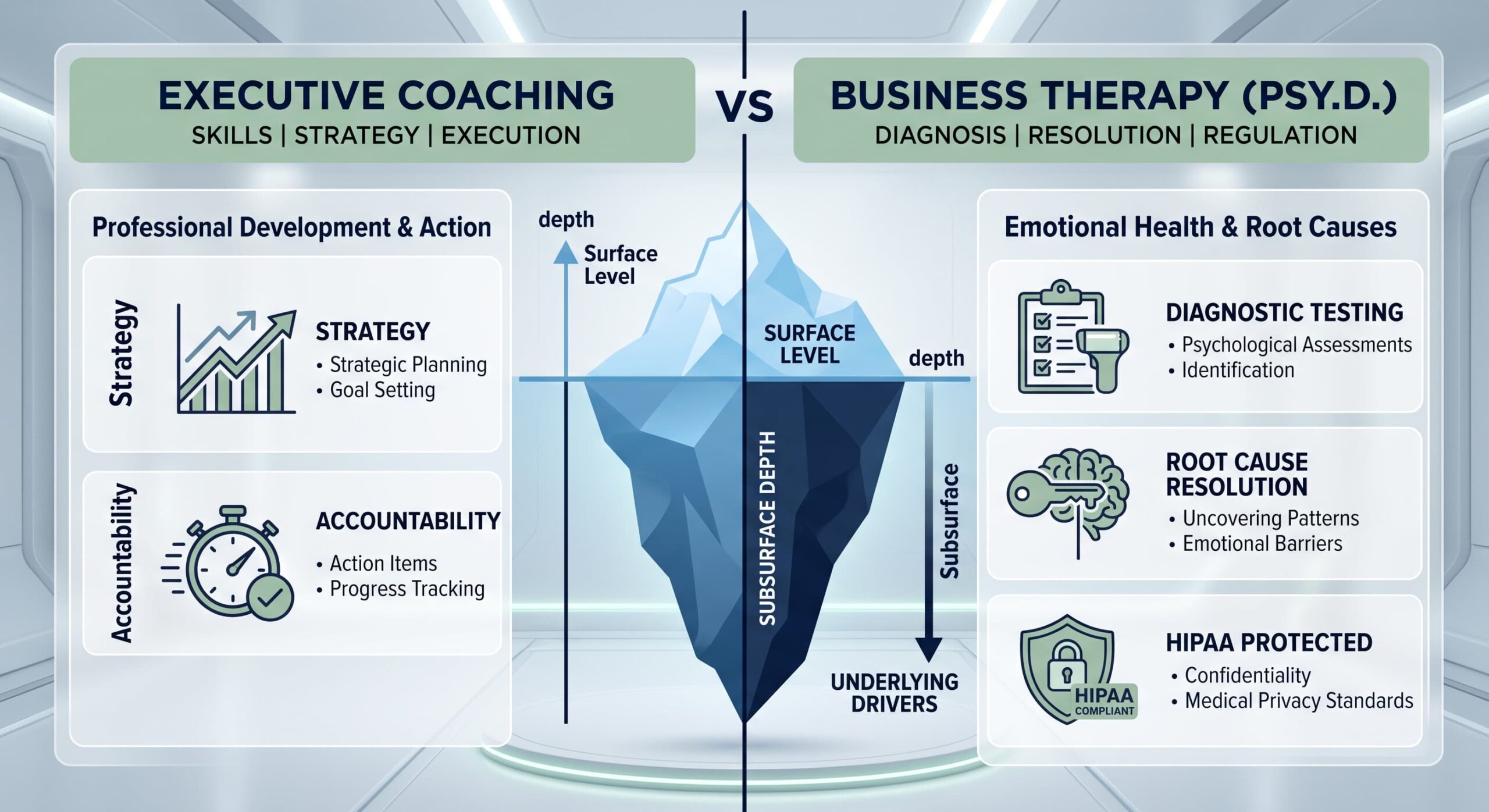
Many founders confuse coaching with therapy, often because the unregulated coaching market has adopted clinical language.
While both modalities aim to improve your professional life, they operate on entirely different planes of depth, authority, and safety.
A business coach is an accountability partner. They look at your current goals, help you map out operational steps, and push you toward execution.
A business therapist, however, is a solution-architect for your mind. We do not just ask what you are doing; we diagnose why your brain resists doing it.
If you are dealing with clinical anxiety, trauma loops, or severe executive dysfunction, a coach simply doesn’t have the training to handle it safely.
| Dimension | Executive Coach | Business Therapist (Psy.D. / Ph.D.) |
| Primary Focus | Future performance, goals, and strategic execution. | Root-cause resolution, cognitive patterns, and diagnostic health. |
| Education & Credentials | Unregulated; varying certifications (e.g., ICF). | Doctoral level training (Psy.D./Ph.D.), state licensure, clinical residency. |
| Scope of Work | Performance enhancement and behavioral accountability. | Diagnosis and treatment of clinical anxiety, ADHD, trauma, and burnout. |
| Clinical Diagnostics | None. Cannot diagnose or treat mental health conditions. | Advanced diagnostic testing (Executive Functioning, Neurodivergence, Personality). |
| Regulatory Protection | None. Conversations are not legally protected. | Bound by HIPAA privacy laws and clinical board oversight. |
| Interstate Accessibility | Varies widely by platform. | Regulated; PsyPact certification allows seamless interstate clinical practice. |
If you need to learn how to delegate tasks, hire a coach.
But if handoffs trigger a physical wave of panic that keeps you working until 3:00 AM, you need specialized clinical therapy for entrepreneurs to address the underlying dread.
The Missing Node: When “Faking It” is Actually “Masking” Neurodivergence
This is what most advice columns on Imposter Syndrome get completely wrong.
When successful founders tell me they feel like frauds, a clinical evaluation often points to something else: undiagnosed adult ADHD or autism.
Because high-performing kids are often highly intelligent, they learn to compensate early.
They build exhausting mental structures to “mask” their executive dysfunction or sensory challenges just to keep up.
In fact, research led by Dr. Michael Freeman at UCSF highlights that entrepreneurs are disproportionately affected by psychiatric conditions, presenting with significantly higher rates of ADHD compared to the general public.
Neurodivergent masking is the unconscious process of suppressing natural cognitive traits to blend in. For a founder, masking executive weaknesses looks and feels identical to Imposter Syndrome because you are performing a role every day just to keep up.
Why Undiagnosed Adult ADHD Often Mimics Executive Imposter Syndrome
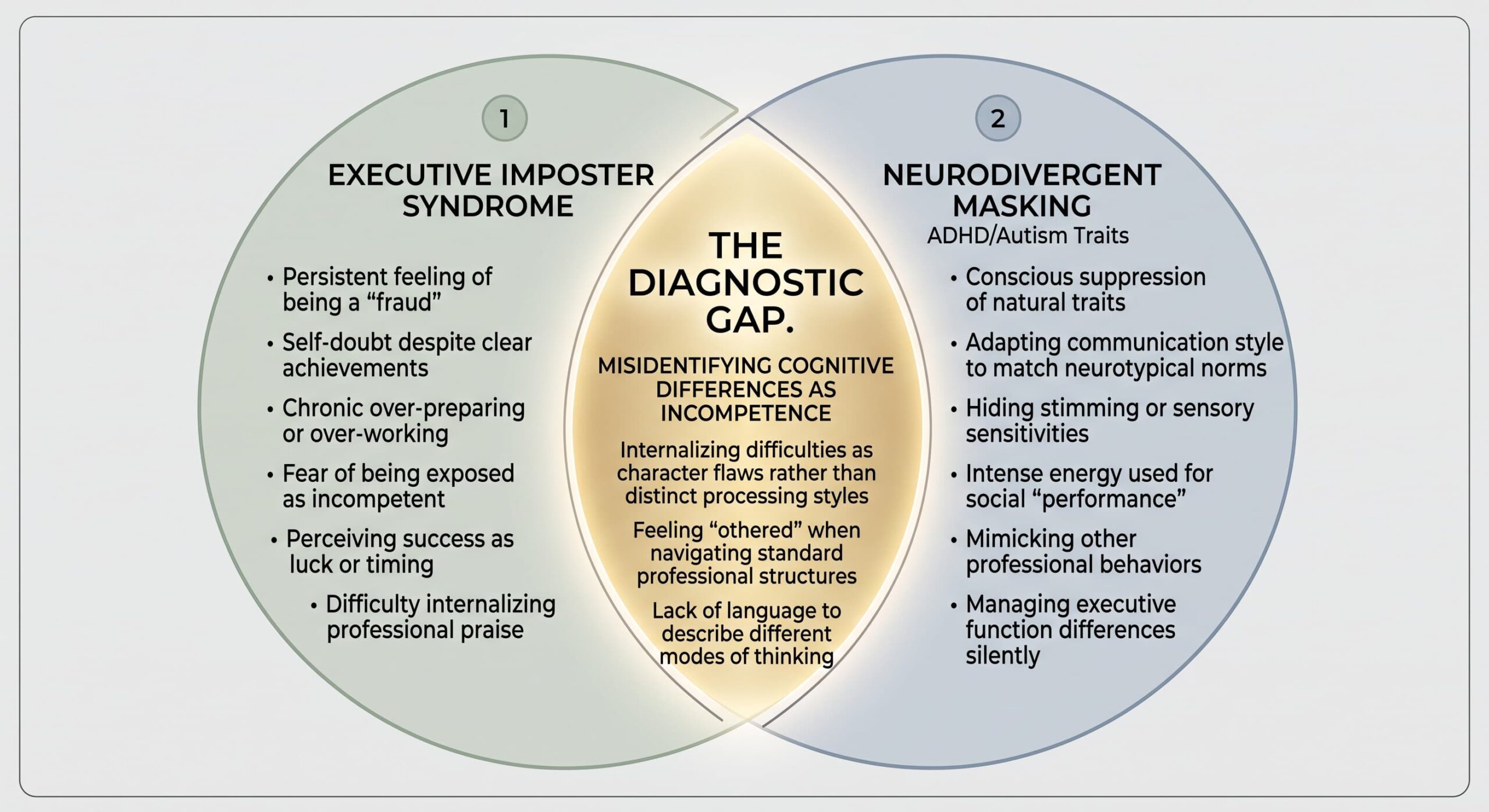
When diagnosing executive distress, we must separate confidence from structural processing differences.
As the National Institute of Mental Health (NIMH) points out, adult ADHD rarely looks like physical hyperactivity. It shows up as chronic trouble prioritizing, poor working memory, and trouble organizing thoughts.
Your brain’s control center literally operates on a different setup.
Starting a pitch deck feels impossible, not because you are lazy, but because your brain is dealing with a dopamine bottleneck.
When you get stuck, you don’t diagnose your executive function. You tell yourself: I’m lazy. I’m incompetent. Everyone else makes this look easy.
Getting a precise, clinical diagnosis changes everything. You can stop trying to force-fix your confidence and start building systems that fit how your brain actually processes information.
Diagnostic Intermission
Before trying to think your way out of a physiological block, you need to understand how your brain actually works.
If you suspect a deeper issue is at play, take a look at our clinical psychological evaluation guide to see how a formal assessment works.
The Clinical ROI: How Psychological Clarity Increases Decision-Making Speed
As a founder, your primary contribution to your business is not your labor; it is your decision-making speed and quality.
Ignoring clinical anxiety or executive struggles acts as a massive, invisible tax on your startup’s momentum.
Because you fear being exposed as incompetent, your decision-making loop bogs down:
- Analysis Paralysis: Burning hours looking for more data points just to confirm a low-risk choice.
- Micromanagement out of Fear: Refusing to hand off tasks because you’re terrified a teammate’s error will prove you’re incompetent.
- Avoiding Conflict: Delaying hard performance conversations or board updates because you can’t stomach the emotional friction.
Addressing these patterns through therapy has a direct business payoff.
Once you detach your self-worth from your cap table, you get your brain back.
Decisions that took three sleepless weeks are settled in a clean hour. You shift from survival to growth.
How to Identify if Your Challenges Require Clinical Intervention (5 Indicators)
How do you tell the difference between normal startup stress and a pattern that needs professional clinical help?
If these physical and mental signals sound like your daily life, it is time to look beyond coaching.
- Physical Toll: Your anxiety shows up as chronic insomnia, stomach issues, or tight chest and shoulders.
- Framework Failures: Productivity hacks, trackers, and coaching don’t scratch the surface of your overwhelm.
- Brain Fog: You struggle with short-term memory, can’t focus, and lose your train of thought in meetings.
- Hard Avoidance: You drag your feet on crucial investor emails or board decisions because you’re afraid of failing.
- Collateral Damage: The pressure of keeping up appearances makes you irritable at home or short with your co-founders.
If these signs ring true, read more about how our clinical psychology team works with executives.
The Open Minds Approach: Answers in 48 Hours via PsyPact
We know you don’t have months to wait around in a healthcare queue.
With a business on the line, every week of uncertainty compounds your stress.
Our practice is structured to match the speed, discretion, and interstate flexibility that startup leaders actually need:
- Fast Diagnostics: We skip the typical six-month waiting list, getting you evaluated and answered in days.
- State-Line Flexibility: Because we’re PsyPact certified, we can provide legally protected telepsychology across state lines, working with you in over 40 states.
- Clear Plans: No endless talk therapy. You get a concrete, data-driven diagnostic report that tells you exactly how your brain works and what to do next.
Stop trying to coach your way out of a physiological challenge. You deserve real answers.
Reclaim Your Cognitive Freedom
If you’re ready to look at the actual data behind your mental roadblocks, let’s talk.
Schedule a Diagnostic Consultation to speak with our clinical team and find out exactly what is blocking your performance.
Frequently Asked Questions About Business Therapy
Does business therapy count as a business expense?
Many founders run executive mental health evaluations or performance therapy through their companies as professional development. Check with your CPA to see if this fits your tax structure.
Can I see a business therapist if I reside in another state?
Yes. Through PsyPact, our doctoral-level team can legally treat patients across state borders. You can get specialized clinical care in any of the 40+ participating states.
How does business therapy differ from traditional talk therapy?
Traditional therapy is often open-ended. Ours is structured and goal-oriented, combining evidence-backed CBT and ADHD management tools with a real understanding of startup pressure.
What is the turnaround time for a diagnostic evaluation?
We don’t make you wait. Our evaluation process is fast, and we offer expedited clinical reports so you get your diagnostic roadmap within days.
About the Author
Dr. Brianna Matey, Psy.D. is a licensed clinical psychologist and the founder of Open Minds Psychological. Over the past 15 years, she has focused on neuro-affirming diagnostics, helping high-performing leaders identify cognitive bottlenecks and build systems that work. Read more about her background and approach in our clinician directory.
Clinical Safety & YMYL Disclaimers
Clinical Disclaimer: All content and media published on the Open Minds Psychological website are created for general educational and informational purposes only. This content is not intended to serve as a substitute for professional medical or psychological advice, clinical evaluation, diagnostic profiling, or psychiatric treatment. Always seek the advice of your licensed clinical psychologist, physician, or other qualified healthcare professional with any questions regarding a mental health or medical condition. Never disregard professional clinical advice or delay seeking care because of something you have read in this article.
Crisis Support & Emergency Resources
If you are experiencing a mental health emergency, severe emotional distress, or a personal crisis, immediate help is available. Please reach out to one of the following confidential resources operating 24 hours a day, 7 days a week:
- Suicide & Crisis Lifeline: Call or text 988
- National Emergency Services: Call 911 (or proceed to your nearest emergency room)
- Crisis Text Line: Text HOME to 741741 to connect with a crisis counselor